All work

Field report · DoD program

Status: Shipped client work

Modernizing DoD workflows

Three ServiceNow applications that replaced paper, email and manual audit research for 500+ people.

Client
Seneca Resources · EY · U.S. Department of Defense
Role
Lead Product Designer & Front-End Developer
Team
Design direction across 3 apps; managed up to 3 designers
Platform
ServiceNow App Engine
Cadence
2-week sprints, quarterly funding
Real screens stay under NDA. Interfaces shown are faithful rebuilds with fictional data.
The problem
Audit research, cross-installation comparison and confidential correspondence depended on manual steps and long email chains.
My part
Owned design direction, new record pages and information hierarchy across all three apps. Managed up to three designers on the largest app as they extended my established patterns.
Result
Three applications remain in use by 500+ people. End-to-end processing moved from a reported 1–2 months before the application to 1–2 weeks observed in dashboards. Other departments reused my designs with implementation guidance.
Why it mattered
Audit research and confidential correspondence ran on manual steps across military installations. Quarterly funding and two-week sprints kept scope and priorities part of every design conversation.
The main decision
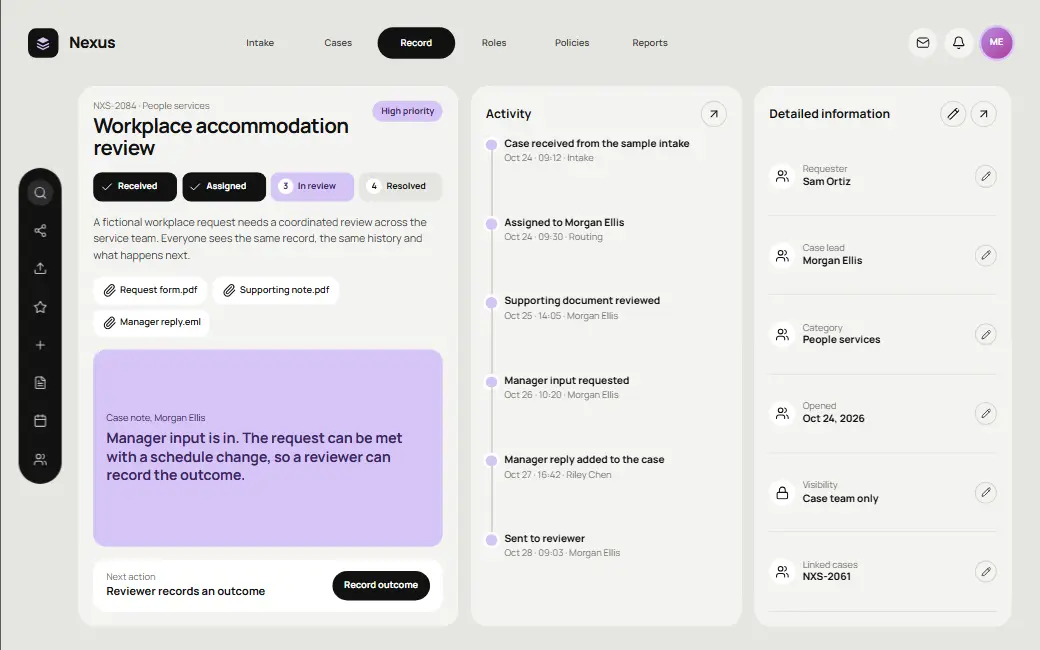
Organize around the task, not the database. Instead of screens that mirror the database tables.
What I took from it
Simplify the route through the work without hiding what each person is accountable for.
3
applications shipped and still in use
500+
people using them across the program
1
program standard: my direction, adopted by leadership
3
designers led on the largest application

One program, three products

Real screens stay under NDA. Interfaces shown are faithful rebuilds with fictional data.

Work ran on paper

  • Historical records lived in disconnected files
  • Confidential correspondence moved by hand
  • No shared view of who owned the next step

The case in four moves

  1. Problem

    Manual, physical processes

    Work moved by hand between people and departments. Nobody had a shared view of progress, ownership or the next action.

  2. Decision

    One shared record per piece of work

    Record states, ownership-sorted lists and role- and stage-aware pages, with the conversation kept on the record.

  3. Implementation

    ServiceNow App Engine, extended

    Custom CSS and front-end behavior adapted the platform's components for quick and bulk assignment and custom dashboards.

  4. Outcome

    1–2 months became 1–2 weeks

    End-to-end processing, from a reported pre-application timeline to what the dashboards showed afterward.

Who did what

I set the direction and kept it. Other people shaped the work in specific ways, and the credit is split accordingly.

My part: direction and ownership

  • Original visual guidelines and application appearance
  • Shared patterns and information hierarchy across all three apps
  • New record pages and major design decisions, throughout
  • Discovery and feedback calls with the test group
  • Front-end revisions: page hierarchy, objects, workflow states, user access, custom behavior
  • Managing up to three designers and mentoring them on ServiceNow
  • Contributing designersJoined and left over time; extended pages using the patterns I established.
  • Lead developersHandled the larger technical problems.
  • StakeholdersSupplied visibility requirements and asked for a way to discuss work.
  • Test user groupReviewed pages and processes and asked for faster assignment.

From user problems to shipped decisions

Six decisions in the shipped applications. Each sketch is a reconstruction of the pattern, not the real screen.

Reconstruction, fictional data
  1. Visibility

    Make ownership visible

    Manual handoffs made it difficult to understand who needed to act next. I designed record states and dynamic lists organized around user profiles and department ownership so people could sort and locate the work relevant to them.

  2. Hierarchy

    Adapt the record to the task

    Stakeholders supplied role and stage visibility requirements. I translated those requirements into page hierarchy and conditional sections, iterating when essential information needed more prominence.

  3. Communication

    Keep conversations with the work

    Stakeholders needed a way to discuss records. I proposed persistent discussions and live messaging inside the record so people on different schedules could recover context without waiting for a previous contributor to reply. Other applications reused the approach.

  4. Continuity

    Support continuity

    I designed availability and backup coverage so urgent work could reach an available person. Historical record access preserved the ability to review previous work.

  5. Assignment

    Respond to assignment friction

    The test group needed faster assignment. I reduced steps and introduced quick selection and bulk or group assignment, adapting ServiceNow through CSS and custom front-end implementation.

  6. Analytics

    Make performance inspectable

    I designed custom dashboard interfaces over ServiceNow analytics. Supervisors could inspect processing time, workload, activity and records by state to understand progress and follow up.

One record, different priorities

Stakeholders said who needed what, and when. I turned that into page hierarchy and conditional sections. Switch the role and stage to see the pattern.

Reconstruction, fictional dataRules generalized for public view
Viewing as
Record stage

Reviewers get the next action and the information it depends on first.

The judgment call. Stakeholders sometimes needed information more prominent than my compact first layouts allowed. I explored variants and revised the hierarchy, keeping essential information visible without crowding the rest.

How feedback changed the product

A test user group reviewed pages and processes. I led the discovery calls, reconciled their feedback with required information, explored variants and revised the hierarchy. When pages were already built, I handled the front-end changes, including objects, states and access behavior. This kept design decisions connected to what users actually experienced.

  1. Test group reviewsPages and processes, in the apps
  2. Discovery and feedback callsI led them and interpreted requests
  3. Weigh against requirementsDefend a decision, or take the change
  4. Explore variantsRevise the hierarchy and interaction
  5. Change the buildI implemented front-end changes on built pages
Illustrative diagram

One pass through the loop

Assignment, before and after the feedback

What the test group hit

  • Open one record
  • Find the assignee
  • Save, go back
  • Repeat for the next

What I changed

  • Fewer steps
  • Quick selection
  • Bulk or group assignment

Built by adapting ServiceNow's available components with custom CSS and front-end code.

The "before" steps are a generalized illustration. No assignment-specific time saving was measured, so none is claimed.

The operational result

This was an application and team outcome. My contribution connected workflow visibility, communication, assignment and continuity. The comparison is based on my account of the prior timeline and post-launch dashboards.

End-to-end processing, from a record's start to its completion

Before the application1–2 monthsReported pre-application timeline
After the application1–2 weeksDashboard-observed, end to end

Bars show ranges, with months drawn at about 4.3 weeks. The account does not establish a sample size, observation window, average or controlled comparison, so no percentage improvement is claimed.

How the patterns left my team

Engineers from other departments contacted me for my source code and designs. I held meetings to explain the process and help them apply the visual guidelines and interaction patterns to their applications. Program leadership adopted the direction as a standard for future teams in the program.

Illustrative diagram

Where it started

Application 1 Application 2 Application 3My original direction

What moved

Visual guidelinesInteraction patternsDiscussion inside the recordSource code and designsWalkthrough meetings I led

Where it went

Other departments' applications Program standard for future teamsNo team count is claimed

Public examples use generalized descriptions and reconstructed interfaces. The case captures my responsibilities and decisions while omitting the underlying operational sequence.

The patterns, rebuilt to inspect

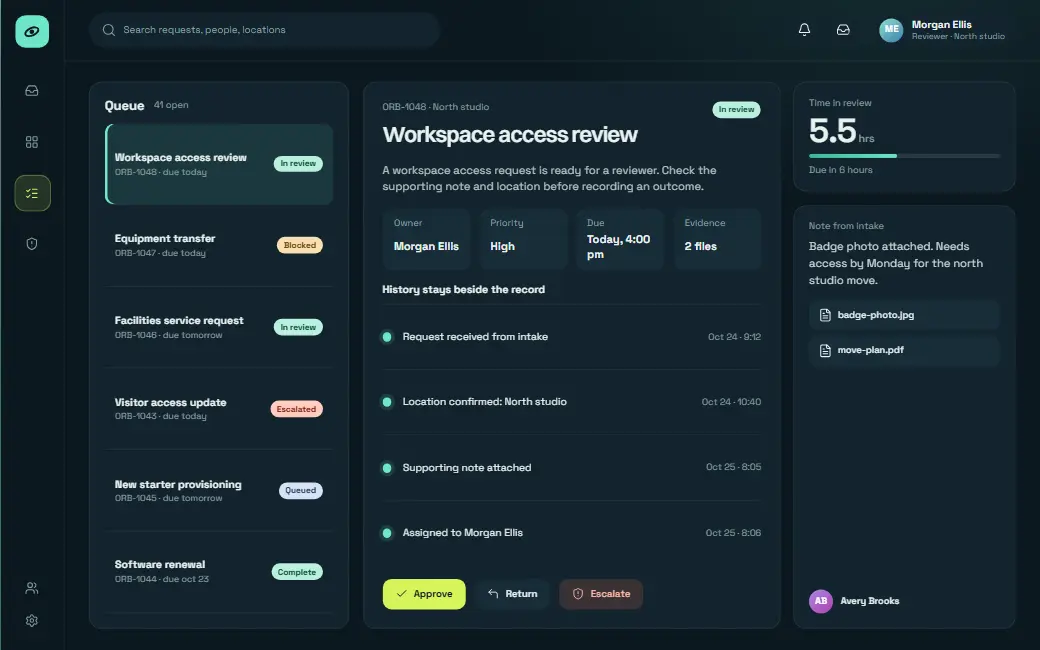
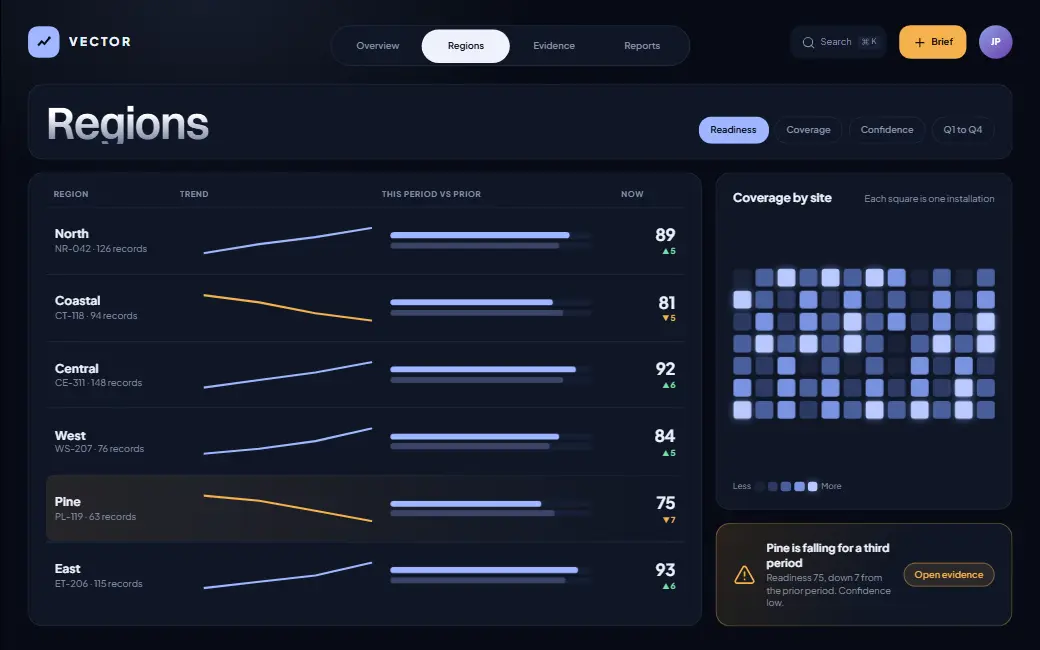
Orbit, Vector and Nexus are portfolio reconstructions informed by this work, with fictional data. They are not separate shipped products.

Organize around the task, not the database

Every screen answers three questions: what is this, who owns it, what happens next. Records keep their history beside the current state.

Instead of screens that mirror the database tables.

Put comparison where the decision is made

Historical and current audit data stay side by side, so analysts compare installations in one view.

Instead of exports and a separate report for each period.

One pattern library for three products

Navigation, validation, role-aware actions and status feedback behave the same everywhere. Leadership later made this the standard for other teams.

Instead of letting each application settle its own patterns.

Illustrative design evidenceConceptual reconstruction / fictional data
  1. 01

    Foundation

    Semantic tokens, type, spacing, and focus

  2. 02

    Component

    Editable content and explicit states

  3. 03

    Pattern

    Context, permissions, and recovery

  4. 04

    Product

    Workflow and service responsibilities

Inspect Figma, code, and Storybook

How this work fits my practice

This shipped program brings together my discovery, design direction, systems thinking, mentoring and front-end implementation.

  • Discovery
  • Design direction
  • Systems thinking
  • Mentoring
  • Front-end implementation

Try the working prototype

This is a real, clickable build of Modernizing DoD workflows with fictional data. Nothing you do leaves your browser.

Shipped and adopted

  • Three applications delivered and still in service for 500+ users
  • Paper and email handoffs replaced by tracked digital workflows
  • End-to-end processing moved from a reported 1–2 months before the application to a dashboard-observed 1–2 weeks afterward
  • DoD leadership adopted the visual and interaction direction for future teams in the program