
Product manager / project lead
Agree the user problem, prioritize the recovery path, define the scope of the first increment, and defer bulk approval until individual review is clear.
// Process · Decision path
The work is not a fixed checklist. The right methods make risks visible, align the team and connect insight to implementation.
01 / The decision path
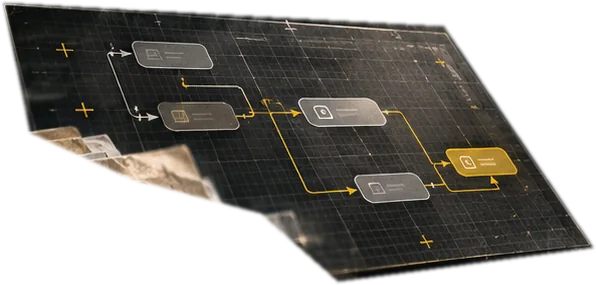
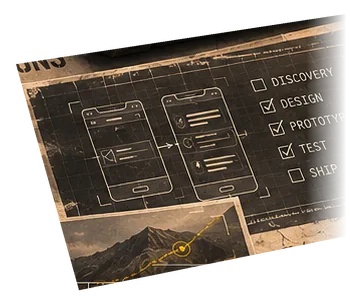
Each stage answers a question, leaves an artifact behind and hands something specific to the next. Methods are chosen per project: not every project used every stage or artifact.
01 / 06 · Business goals, user needs, constraints
What job is actually being done, by whom, and under which constraints?
02 / 06 · Workflows, information architecture, journeys
How does work move, where does it wait, and who owns each step?
03 / 06 · Wireframes, prototypes, alternatives
Which interaction model solves it, and what does each option give up?
04 / 06 · Components, patterns, design systems
What should be reusable, and what is truly a one-off?
05 / 06 · Engineering partnership, design QA, iteration
Does the build match the intent, in every state and at every screen size?
06 / 06 · Feedback, measurement, next iteration
Is it working, and what should the next increment change?
02 / The lens
What did we learn about the job, the system or the constraint?
Fictional Orbit exampleReviewers find missing evidence only after they open a request.
Which direction best solves the problem, and what does it sacrifice?
Fictional Orbit exampleEvidence completeness matters more than minimizing clicks.
How does the interface and interaction model express that decision?
Fictional Orbit exampleKeep the record and queue together, explain the blocker, give the requester a way to recover.
03 / Representative Orbit delivery brief · fictional example
A reviewer finds missing evidence after opening a request. The proposed response keeps the record and queue context together, explains the blocker, and gives the requester a recoverable path. This brief illustrates a collaboration method; it is separate from my résumé-reported delivery history.
Shared decisionEvidence completeness before speed
Agree the user problem, prioritize the recovery path, define the scope of the first increment, and defer bulk approval until individual review is clear.
Review the state model and API constraints. Keep record identity stable, preserve entered feedback on failure, and enforce permission rules in the service.
Turn state specifications into acceptance checks: missing evidence blocks approval; failure preserves input; retry avoids duplicate submission; narrow screens and keyboard use retain access.
Review the approval responsibility and audit requirements. Agree that evidence completeness matters more than minimizing clicks, and select measures for a later evaluation.
04 / Design + engineering
My front-end background helps me evaluate constraints early, review built experiences against design intent, and work with engineering to resolve issues before release.
<Status variant="warning" />05 / Outcomes and evaluation
I define desired outcomes early, then choose measures with the team that can show whether the experience is working.
Task completion time · steps required · manual work removed
Set with the teamError rate · completion rate · exception handling
Set with the teamFeature usage · repeat usage · workflow completion
Set with the teamUser feedback · usability · support friction
Set with the teamComponent reuse · implementation consistency · design debt
Set with the teamThese are candidate measures for future evaluation, not reported project results. Not every engagement exposes every metric, but I define desired outcomes early so decisions can be evaluated against something more meaningful than preference.
06 / How products behave
A polished interface is more than its resting state. I design how products respond, communicate status, preserve context, and recover as people move through complex workflows.
Confirm the action immediately, then show its outcome.
Commerce · add to cartKeep the queue in view while someone works through a record.
Orbit · queue to detailMake permissions and available actions clear for each role.
Nexus · role switcherUse small transitions to clarify changing data, not to delay it.
Vector · filter and drill downWant the full set? The interaction lab has twelve working patterns.
I use discovery workshops, interviews, workflow maps, information architecture, prototypes, usability feedback, component specifications, and design QA where they help answer a real product question. I avoid artifacts that exist only to decorate a case study.